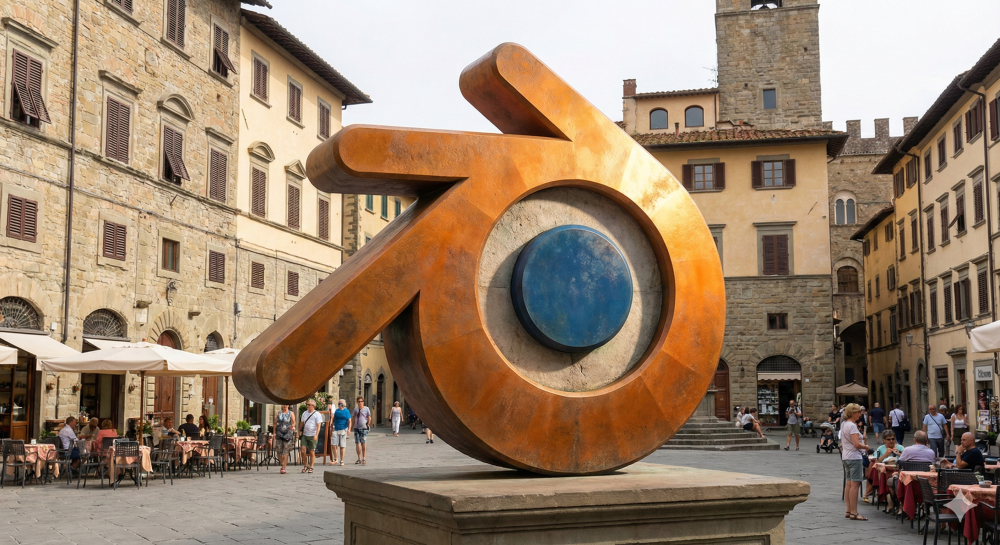
COrtonaOPen3d 2026 is a Computer Graphics and Project workshop in the context of Cultural Heritage that will take place in CORTONA (AR) on the following dates: 23-26 July Blender Course \ 27 – 31 July Project Workshop \ Saturday 1 August final presentation and award ceremony of the projects
During the workshop, participants will develop individually or in groups an architecture-design project or an artistic installation.
The project workshop will be preceded by a course on BLENDER 3d Open Source Software

The 2026 edition will be held both ONLINE and IN PERSON – It will therefore be free to choose whether to follow the workshop in person (even partially) or completely online. The workshop is in its XV edition and lasts 100 hours, with every year between fifty and one hundred students participating in total.
The workshop is international; students from all five continents have always participated, and the languages spoken are Italian, English, and Spanish. It is held in collaboration with the Polytechnic of Milan, the Academies of Fine Arts of Brera (Milan) and Urbino, and the ESDA, Escuela Superior de Diseño de Aragón.
The workshop program includes lessons, conferences, communications, and a laboratory with project reviews and tutoring dedicated specifically to the Blender software. The communications will be held by university and academy professors, local authorities, and experts in digital issues. In the foreground the development of highly professional advanced digital content with modeling using Blender and 3D photomodeling software and implementation of AI tools.
Participants will have to create a design project in the Cultural Heritage field. The projects will be carried out by students using the Blender software (which runs well on any PC or Mac, even dated ones), working within one or more digital models with very high resolution, quality, and detail. The models are created and provided by the organization with the help of the most current photomodeling tools, of which we will teach you the theoretical and practical bases so that you can create your own independently.
The aim of the workshop is to teach how to design using the computer as a creative tool and to raise awareness among participants of the issues of the project for cultural heritage in fragile urban contexts and therefore: LEARN TO DESIGN USING 3D SOFTWARE IN A CREATIVE AND CONSCIOUS WAY
For any information or questions, write to us at: info@cortonaopen3d.org we will be happy to answer you.
WHAT IS IT STUDIED AND HOW?
- Blender fundamentals during the online course that will precede the workshop.
- Advanced Blender techniques: practice the most advanced and innovative techniques of this extraordinary software with the constant help of our tutors.
- Photography and 3D digital photo modeling: Photography, its language, and its use in 3D digital modeling techniques.
- Designing for Cultural Heritage: Deepen the relationship between contemporary design and cultural heritage.
- Experimentation with AI tools like Midjourney or NanoBanana and their implementation within Blender
- By following the lessons that will address in depth the different themes of the workshop with numerous external contributions from architects, artists, administrators, Blenderists, professors, and digital technicians.
- By designing within a hyper-realistic virtual model of the project area that will be provided by the organization.
- You will be guided by us and our Blender expert tutors from both a technical and design point of view.
THE VIRTUAL MODEL
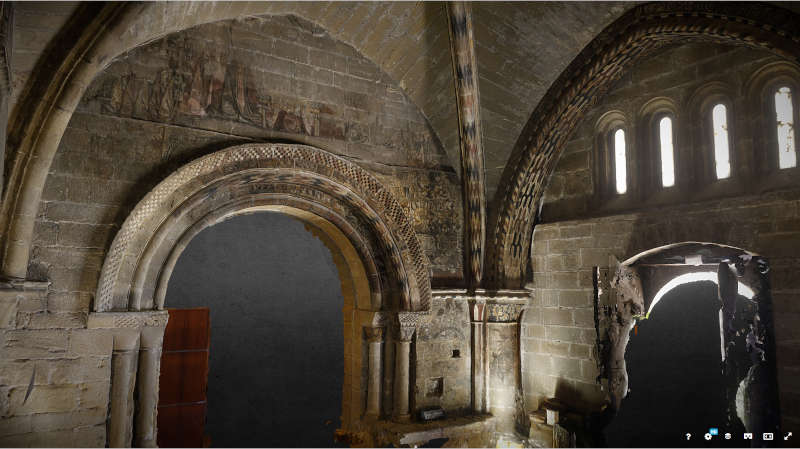
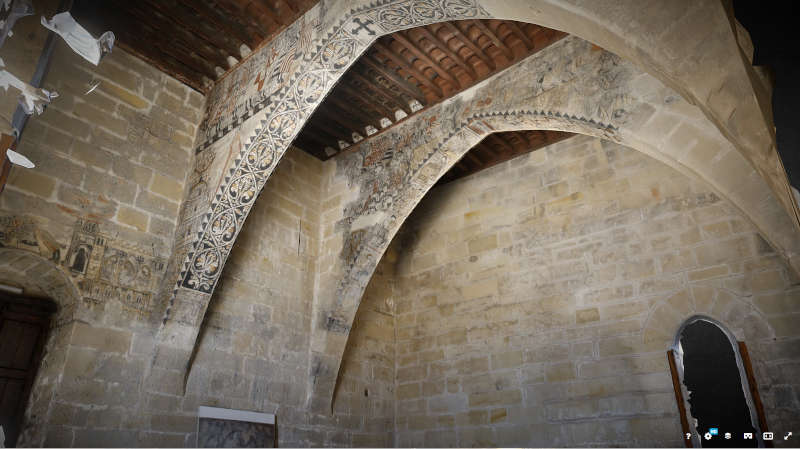
The virtual model of the project area will be provided by the organization: below you can browse some examples of models created in the past. During the workshop, you will receive a similar, higher-quality model of the project area, which you can then use to develop your own project.

UNIVERSITY CREDITS
They will be recognized with participation in the workshop: 4 CREDITS for the Architecture students of the Politecnico di Milano
We recommend that you check your personal credit eligibility before the workshop. If you have any questions or concerns, please contact us at info@cortonaopen3d.org and we’ll be happy to assist you. (it is usually possible to validate the credits by inserting the workshop in both the current and next academic year’s study plan; always ask for confirmation in the secretariat)
To obtain the 4 credit, upon successful completion of the workshop, you will receive a certificate of participation. This will allow you to demonstrate your professional knowledge of the software and request credits by following the instructions on the Polytechnic University website. https://www.auic.polimi.it/formazione/tirocini-e-workshop/workshop
THE WORKSHOP IS OPEN TO ANY UNIVERSITY STUDENT, even from other universities. Write to us for information.
COSTS
All workshop participants will be asked to make a “contribution towards the cost of teaching materials.” of 250 euros.
The contribution is the same for those who participate online and those who participate in person.
We are proud of the fact that the workshop does not receive any type of funding and has always been supported exclusively by the fees for teaching materials paid by participants. Your support allows us to be free and to teach only what we truly believe in.
Note: Travel, food, and accommodation costs for those who decide to participate in person are the responsibility of the participants.
BLENDER COURSE
The Workshop will be preceded by a BLENDER course, useful for learning or deepening Blender and for obtaining a good knowledge of the software IN ITALIAN AND ENGLISH
- Modeling The first phase of a 3D project is the creation of a three-dimensional model starting from Euclidean solids, either from scratch or from a drawing previously made with CAD software. It is also possible to import and modify objects and architectures acquired from the network. Keywords: Modeling for objects, parametric, from CAD; Import and export of 2D and 3D models.
- Materials and textures Materials (Shaders) must be applied to the three-dimensional model, which can be very simple or extremely sophisticated. It is possible to create the material from scratch or to import it from one of the numerous libraries freely available on the net. Keywords: materials; procedural and image textures; image mapping and unwrapping.
- Lighting In a 3D scene, light sources must be inserted. These are positioned with reasoning similar to that of a photographic studio; obtaining good lighting requires some care but allows for excellent results. Keywords: Color and Light; indoor and outdoor lighting; issuing materials; unbiased rendering with Cycles.
- Photography and photo shooting The choice of camera positioning allows you to tell the project in the best way. The “photographer’s eye” depends on talent and experience, but also on some rules and techniques that apply to the creation of a render. Keywords: virtual cameras, depth of field, photographic composition.
- AI. The ability to have Blender interact with AI is certainly a great opportunity to renew, speed up, and enrich the project process. This is especially true because Blender is open source, allowing AI to “read” the software’s structure and operate within it, speeding up operations and enabling previously unimaginable interactions.
SOFTWARE LESSONS AND CONFERENCES
Communications will be a fundamental part of the workshop, providing the technical and cultural knowledge necessary for the creation of a concrete project, with attention to detail and capable of significantly enriching the participants’ portfolios both in terms of graphic communication and project content. They will be held by university professors, local authorities, and experts in digital issues.
- Inside the city walls _ Stories, tales, and analyses of the city, its cultural heritage, business realities, and its territorial context.
- Designing for Culture _ Innovative design, art, and architecture projects in the contexts of Cultural Heritage
- Is it build? The image in the digital age _ New trends in project communication through photography and rendering
- Advanced digital tools Software and hardware for digital design, theory, and practice.
DESIGN COMPETITION
Participants will participate in an artistic or architectural design competition in which they will have to create a design project within the city of Urbino or Milan. The details are still being defined, but you can stay constantly updated on the news in real time by: PRE-REGISTRATION or writing to us at: info@cortonaopen3d.org for any questions.
Projects will be carried out individually or in groups, guided by teachers and tutors who are experts in design, planning, art history, and software. They will work using the open-source Blender software within a digital model with very high resolution, quality, and detail, created with the help of photogrammetry tools, also open source, provided by the organization.
Like every year, the projects presented and developed during the competition will be evaluated by two different juries. The first will be composed of the participants of the workshop themselves, who will vote for the best project among those created by their classmates. The second will be composed of university professors and prominent figures chosen by the organization of the workshop and the municipal administration.
The project will be a work of design, art, or architecture and will be illustrated to the juries with a series of rendering images created using the Blender software. The two juries will evaluate the quality of the projects, the beauty of the images, and their coherence with the premises of the workshop, assigning the symbolic prizes up for grabs and decreeing, for “future glory,” the winner.
PARTICIPATION
The project theme will be in the context of the city of Cortona (Arezzo, Tuscany)
You can freely choose whether to participate in the Workshop in ONLINE or IN-PERSON mode. All the workshop activities will be available through the web.
If you participate in the Workshop you will be able to:
- Attend the BLENDER COURSE that will precede the workshop. The course is designed to obtain adequate knowledge of Blender to successfully develop the workshop project.
- Attend the conferences ONLINE or IN PERSON
- Participate in the project workshop alone or in a group, with project reviews and Blender tutoring. You will create the project using the extraordinary hyper-realistic models of the project areas provided by us, created through photogrammetric three-dimensional modeling.
- Present your work to the expert juries and the participants’ juries and be evaluated among the best projects of the Workshop
To participate in the Workshop and obtain credits you must:
STEP 1 – Fill out the PRE-REGISTRATION FORM for the workshop (you can find the link in the main menu of the site). We will then send you the instructions needed to complete the registration and make the payment for the teaching materials. Pre-registration is not binding.
STEP 2 – Complete the registration by paying the fee for the teaching materials. Registration allows you to receive the teaching materials (3D models etc…) and participate in all the initiatives as well as, obviously, the Blender course preparatory to the workshop.
STEP 3 – Participate ONLINE or IN PERSON
- ONLINE If you participate online, you will simply need to make sure you have an internet connection available for the entire duration of the workshop. All activities will be fully available and the workshop will also be accessible to those who work remotely. It will be stimulating to design with colleagues located, literally, on the other side of the world. In fact, for several years we have developed a “system” to put you in contact and be able to work even remotely, which has proven to work excellently.
- IN PERSON If you participate in person, you will need to organize your travel and your stay. Travel, accommodation, insurance and internet connection expenses are the responsibility of the participants. “In person” participants will be able to work in their accommodation and/or in the classrooms made available and/or in the courtyards and open spaces.
- While we can’t directly arrange your travel and accommodation, we can provide you with any information you need to find the right accommodation and transportation for your needs, using the most common methods.
- The cheapest accommodation we can recommend (25 euros per night) is the Ostello San Marco in Cortona (here you can find all the details: https://ostellocortona.it/ )
Note: An internet connection is necessary and is the responsibility of the participants, whether they are online or in person, for the entire duration of the workshop.
PROJECT THEMES: DESIGN & CULTURAL HERITAGE
Using the intelligence of objects and software to think and design is the project theme of Workshop 2026. Software is becoming, in some ways, “intelligent,” and design and art can no longer reasonably avoid the topic. It is essential to know how to design “from the spoon to the city,” understanding that today, anyone designing a house, a museum, a chair, a poster, or any “thing” cannot avoid asking the question of “if” and “how” to interact with technologies and the level of intelligence they have achieved.
Above all, it is important to intelligently rethink the context and the relationship between technology and the world of cultural heritage in fragile contexts, exploiting in an innovative and coherent way the possibilities offered by connection technology and finding methods of intervention that make the distortions that technological innovations inevitably cause controllable.
You will be asked to identify and select the critical issues you find most interesting and stimulating within the context of Cortona and the assigned project area. You will then develop an architectural, design, or artistic installation based on these issues that you believe can contribute to improving the quality of life through design. You can work on a territorial or architectural scale, or you can imagine artistic interventions, performances, or installations, according to your sensibilities and inclinations.
This is what we try to do with our Workshop: help designers and communities to come into contact and design objects, spaces, relationships… in other words DESIGN AS A TOOL FOR CIVIL CULTURE.
CALENDAR
WORKSHOP – The workshop will be held from Thursday, 23 July to Saturday, 1 August 2026. The program includes communications, lessons, conferences, and project reviews. The overall duration of the workshop is 100 hours.
BLENDER COURSE – The course will be held in Italian and English (using Blender in English as always) and will be available both in live streaming (we will use Zoom) and at a later time via registration.
- Thursday, July 23th – Blender Course and Lectures
- 09.00 – 13.00 Blender Course 14.00 – 20.00 Kick Off Event, lectures, Introduction to the Workshop Blender Course
- Friday, July 24th – Blender Course and Presentations
- 09:00 – 13:00 Blender Course Presentations; 14:00 – 20:00 “House Rules” – Virtual Tour – visit (virtual or real) of the project area. Start of the Project Workshop: presentation of the digital models and exposition of the working methods. Formation of the groups, Present yourself.
- Saturday, July 25 – Blender Course and Workshop
- 09.00 – 13.00 Blender Course 14.00 – 18.00 Workshop 18.00 – 20.00 Personal Work
- Sunday, July 26 **- Workshop
- 09:00 – 13:00 Workshop 14:00 – 18:00 Workshop 18:00 – 20:00 Personal Work
- from Monday, July 27 toThursday, July 30 – Software Lessons and/or Workshop
- 09.00 – 13.00 Software Lessons and/or Workshop 14.00 – 18.00 Workshop 18.00 – 20.00 Personal Work
- Friday, <July 31 Workshop and Final Delivery
- 09.00 – 13.00 Workshop 14.00 – 18.00 Workshop 18.00 – 20.00 Delivery of the final projects in PDF format
- Saturday 1 August – Presentation and Discussion of the projects
- 09.00 – 13.00 Presentation of projects, evaluation by the expert jury and the jury of participants and Awarding of winning projects 14.00 – 20.00 Discussion of projects with the tutor jury and professors
 COrtonaOPen3d2026